
 I once had a gay neighbour, who proudly announced when we first met that he too wanted to be a minister, but then fell in love with a man. I appreciated and admired his candor. If we were going to be neighbours and friends, (which we did become) it had to be on ‘real’ terms. Neither of us was going to stay in the closet. But I was never going to tell him ‘oh you shouldn’t live like that’ or ‘that’s bad for you man’. The apostle Paul says ‘we are not to judge those outside the church’. So is there any place for Christians to encourage Biblical definitions and values about marriage on those outside the church?
Bono or Bilbo Baggins?
In my recent posts, Why Bono supports gay marriage I suggested that Bono’s support for gay marriage may be influenced by C.S.Lewis’ attitude to marriages outside the church; namely let those outside the church have one set of rules and those inside have another. Consequently, faith is kept private, but sketched by Bono in the lyrics of U2’s songs and shared in conversation with only with those who ask. We also noted how Lewis's friend, J.R.R Tolkien, disagreed with him arguing that 'what is good for the Christian is good for all humans'. So where do you stand? With Bono or Bilbo Baggins? Ok that's a bit cute. Are you with Lewis or Tolkien?
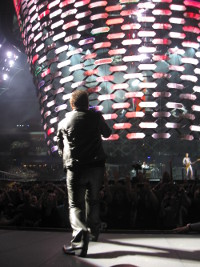
[caption id="attachment_731" align="aligncenter" width="1944" caption="Bono facing the incredible eliptic LED screen during "City of Blinding LIghts" 360 tour"] [/caption]
Bono’s reasons for supporting gay marriage may not be that simple, or it may be even simpler than that. I haven’t spoken to the man so I can’t really know for sure. Though I’m fairly confident he does not wish to come across as a Christian who is judgmental, ‘looking down the nose from a high horse’ at gays and lesbians. I’d say he’s eager to emphasise the very thing he’s so appreciative of, namely, God’s love and forgiveness. Whenever interviewed directly about his faith, he’s been quick to acknowledge he’s a sinner who ‘may not have broken all the commands but has wanted to’. In the words of the first song of their first album back in 1981, ‘I was lost, now I’m found’ (I Will Follow, Boy).
Curiously, having a private faith hasn’t stop Bono from acting on his faith to bring social change. He himself does not keep mum. In many cases, his faith comes out of the closet, most notably in alleviating extreme poverty and the Make Poverty History campaign. However, one thing that is really interesting here is that Bono rarely uses his faith publicly to leverage support for social justice issues. Ok, if he’s talking to a mega church in North America, out come a pile of Bible references to the poor and God’s compassion for the needy. But if he’s talking to the general public or to governments, he’ll be talking about human rights and things like economics and how it is in the interests of governments to act for the poorest of the poor.
I love this about Bono. Some preachers may find Bono easy to criticise, but he works hard to view the world from the standpoint of his opponent or those blocking his path to social justice. He ‘evangelizes’ them for his cause, in terms that resonate with them. Now, how few preachers do that?! Most of us preach from the security of our churches and resonate as far as the middle row, if we are lucky. That’s because we haven’t done our homework to understand the world we live in and how people out on the street actually think. We’ve forgotten what it’s like to be unchristian in today’s society. Or to use a lyric from the most recent U2 album, ‘[we’re] a long way from where [we once were], from where [we] need to be’ (Song for Someone, Songs of Innocence)
Miranda Devine recently gave an example of working from a broader base when she wrote in the Sydney Morning Herald a fairly direct article against the Australian government for entertaining the idea of same sex marriages. She argued that you don’t have to be religious to see the basic building block of human existence is the family, which itself relies on a man and a woman who can procreate:
On this gay marriage issue, if Christians find themselves at odds with the tide of public discourse we might do well to take note of Bono’s broader approach and instead of leading with the Scriptures or the history of the Church or the role of the institution, find the points of affinity with others outside the church who also agree gay marriage isn’t in the interest of humanity. That way, it takes the ball off the opponent. No-one can say ‘fob off Christian, keep church and state separate!’ when you’re arguing from a broader opinion base.
But shouldn’t we keep Church and State separate anyway? AKA: “Christian “fob-off”
A recent article in the SMH lauded Lewis’s stance noting that Australian culture had become increasingly secular and that a “strong majority of Christians favour marriage equality” (“Keep Church Law with the Churches”, by Julia Baird, News Review, SMH June 6-7, p36 2015). It was argued that any disagreement with “marriage equality…inevitability” was for internal “synods and assemblies, not parliament”.
But this whole notion of ‘separation of church and state’ needs questioning. It’s often assumed that it means ‘Christians have no place here’ or ‘religion is not to enter parliament’. First, let’s be all humble enough to admit that no person, religious, atheist or agnostic walks into parliament in a vacuum. Everyone has bias, everyone has predisposition to one view or another. So the point of the Church/State separation thingy was not to keep religion or people of faith or religious points of view or discussion out of the State/parliament. No, no this is the fantasy of atheistic zealots and evangelists for SSM. The actual separation of Church/State idea is to prevent the State from giving inequitable support in favour of one religion over another or going further even and legislating for a State ‘faith’. In this way, the State remains ‘independent’ from the Church, with a separate role, but the two don’t stop ‘talking’. In fact, as history shows, the best situation is one of being collaborative allies for the bettering of society.
Christendom wasn’t all bad
As I noted in the previous blog, ‘Why can’t Christians see gay marriage as a straight equality issue?’, if you’re society is becoming secular like Australia, then you’ve already severed the free society that you enjoy from its source. We got to be where we are from centuries of Christendom. Now what we have in mind is to make it up as we go, minus the Church. But we really can’t do this ‘out of nothing’, what we end up doing is parodying the just society that comes from accepting God’s authority in His word. Hence the battle now to redefine ‘marriage’. We know marriage can be a good thing, but why on earth can’t it be for everyone! Where on earth did this marriage thingy come from anyway? Christians?! Oh bother, not those losers. Who cares what they think? What good have they ever done, except trying to coerce their irrational beliefs on everyone so they can have everything their way? Why can’t we make marriage into a new thing? Yes, we’ll determine what it is based on the shifting sands of human rights and the noisiest voice in the country!
The harmony of two political entities: Church and State.
Today people often assume Church and State are meant to be at war or that they must not communicate with each other for a free and just society. Church is seen with suspicion, as though it will look for anyway to coerce its infantile, outdated, irrational beliefs on a society.
The church as political entity
We all get that a State is a political entity: a person or group of people who represent a larger group of people to administer justice for the benefit of all. But had you ever considered the Church a political entity? Probably not. I don’t mean Rome or a particular denomination. I mean Christians gathered around God’s word, wherever the Spirit of God takes hold. Biblically, the church is most definitely a political entity. How? God’s Son became man; He died and rose as a man. In doing so, Jesus fully represents God to humanity and humanity to God. Jesus’ political reach, is all encompassing but the expression of His rule for now is the existence and growth of the Church. The Church across the ages is then a governed body, recognising its head and source of life, in Jesus. But the Church by nature is non coercive. You don’t get forced into it. You accept it willingly and joyfully. Or you ignore it or repel and fight it.
The Church's presence and speech affirms and 'betters' the State.
The Church does not replace the State or make it irrelevant. Instead, the Church’s political presence reminds the State of its limited but nonetheless God given, authority. A State can act beyond its God given powers and throw its weight around unjustly, even demand allegiance like a deity. Christians down the centuries have suffered, unwilling to give such expressions of State the homage they demand. Examples of the past were Imperial Rome, now we have IS. But to really be in touch with reality, the State needs to accept its own limited role. The Church is the future. The State only a temporary structure to administer justice in society until Jesus returns and justice is complete. Until Jesus returns the Church supports the State’s true function, namely to act justly and in the best interests of the people it represents.
So are you with C.S.Lewis or Tolkien? Should Christians keep mum or speak out against gay marriage?
It’s was on the blood of martyrs that we see the ‘harmonisation’ of Church and State. But today, post Christendom, western liberal societies are chucking out the baby with the bath water. Replacing it with a headless State, a confused society driven by noise. When we hear our words are unwanted and inadmissible, we should remember that is how our ancient forebears probably felt in the face of mighty Rome. But it was the actions and words of the Christians who ultimately won the day and made Rome a better society. It wasn’t through coercion, oppression or violence that Rome caved in and said, ‘hey you guys are right, what have we been doing for the past 300 years!?’ We don’t blow up cars or carry out beheadings. Instead our presence rubs off on society and we speak up, at times suffering for what is right and just.
When speaking individually with acquaintances, neighbours, colleagues and friends I wouldn’t take aim at their moral choices if they are outside the Church. I’d still emphasise God’s kindness to me and how it is open to anyone else who will accept they are a sinner needing salvation. But as a collective, Christians love their society and assist the State fulfill its God ordained role, when we speak as a collective against things that, given what we know in God’s word, are harmful to the world we live in.
For further reading on the Church as political entity and its implications I highly recommend 'The Desire of the Nations' by Oliver O'Dononvan
Stephen Shearsby is a Christian performer and writer
Find out more or book his shows here:
Anton’s Antics www.antonsantics.com Gospel Shows for Children and Families
Barista Banter www.baristabanter.com.au Improve your coffee, rethink life


