 How do you as a parent keep your child open to God even though you might be a skeptic?
What kind of expressions of faith should parents expect of their toddlers?
Jesus said to his disciples in Mark 10:13 ‘do not hinder the children from coming to me, for the kingdom belongs to such as these’.
What does Jesus mean by these words?
Always in the kingdom?
Some argue for immediate inclusion in the kingdom; so kids are ‘in’ until they ‘step out’. Consequently all babies, toddlers, kids, even those in families of different faiths are in the kingdom until they actively choose to reject Jesus. Attractive as this may seem it doesn’t square with what’s going on in the gospels. The disciples are hindering the children from coming to him deeming them a waste of time or beneath Jesus’ interests. So the children are trying to enter the kingdom but obstacles are put in their way by the disciples. Jesus responds by sternly rebuking them and warns that unless the disciples enter like a child, they won’t enter at all. Consequently, I don’t think children of any faith, creed or family automatically belong in the kingdom; they too must enter...
Concept of covenant
So how do they enter? Obviously we can look for signs of faith, like good deeds; turning the other cheek with their siblings; packing up their toys unasked. We could press them for adult like conversion testimonies... “I was blind, but now I see”. Though this I wouldn’t recommend for kids growing up in Christian homes. Instead I’d encourage you to consider the concept of ‘covenant’ in the family.
The concept of ‘covenant’ is drawn from the Old Testament where God’s promises were applied to you and your family. So if you took the promises on as dad or mum, then the blessing (or cursing, if you didn’t hold up your end of the deal) also applied to your kids. We see a similar principle apply in the New Testament where God’s offer of forgiveness is promised to both the gaoler and his family when he asks how to be saved (Acts 16:31)
Spiritual blindness affects us all
After Jesus died on the cross, Luke tells of two disciples walking on a journey to a nearby town outside of Jerusalem (Luke 24). When the risen Jesus appeared to them and began talking with them they failed to recognise him, their hearts weighed down with disappointment and sadness. The ‘stranger’ rebuked them and explained the Scriptures about how the Christ must first suffer then die and rise to glory. Then when he broke bread and gave thanks they were able to recognise him. Their minds were closed; Jesus had to open them so they could see who really was the all conquering King. What was true for these men is true for each one of us, including our kids. We all need our eyes opened; though as we can see from the little event of the children coming to Jesus, some are more ready to open their eyes than others. Some groups of humanity are more ‘proximate’ to the kingdom than others. Some are running in, so we don’t want to be put stumbling blocks in their way.
Circles of closeness or ‘proximity’ to entering
I find it helpful to think of our proximity to the kingdom of God as a series of concentric circles with Jesus at the centre. As we move out from the centre people become further away from entering the kingdom of God.
The first circle of proximity to the kingdom is for those who are closer to entering than anyone else. In the gospels this circle of proximity belongs to children and the sick, lame, blind and poor. Next concentric circle we find women entering ahead of men and lastly the rich and powerful who are most distant from the entering.
So how do we bring our kids closer to God?
- Don’t impede them – first of all we need to get out of the way. The ‘kingdom belongs to such as these’. We should never think they are too young to understand, or pray or participate in the life of faith. So don’t put off praying with your kids or reading the Bible to them or speaking to them about matters of faith. Start early and make the road accessible by using resources that fit their age group (see an example of fun, clear, age appropriate resources below)
- Don’t expect adult like conversions – often people look for kids to behave like adults. But they don’t nor do they need to. Children brought up in Christian homes shouldn’t be expected to have obvious and decisive conversions. Just lots of segways. So make Jesus and his word accessible to them, pray, be a good example to them and let God work through the normal processes he uses to bring about faith. That’s how the ‘covenant’ concept works in practice.
- Let God be God – at the end of the day, you can’t make your kids trust Jesus. So don’t beat yourself up. Remember the story of the two disciples on the road to Emmaus…Jesus had to open their eyes so they could understand the Scriptures and see who he really is. Our kids are no different; God has to open all our eyes from spiritual blindness.
An Easter resource about spiritual blindness
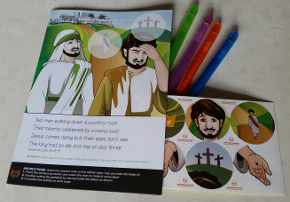
This year Anton’s Antics has published a brand new sticker story for preschoolers (school age version available as well). ‘With Eyes Wide Shut’ (pictured) follows the disciples experience of meeting the risen Jesus and having their eyes opened to see he really is the eternal king.
Available in our store NOW, with a whole range of other sticker stories for the home as devotional packs or in packs of 25 for ministry in churches and schools: http://antonsantics.com/store.html
For the exact resource referred to in this article go to: http://antonsantics.com/store/product/56-with-eyes-wide-shut-before-school-age-sticker-story-25-pack.html
For packs explicitly for parents to use at home go to the 'devotional packs' as shown here: http://antonsantics.com/store/product/35-before-school-age-family-devotions-pack.html